

Bentsifi’s Tattle…Guy about town
Bentsifi’s Tattle…Guy about town
The Economy Of Trust
Redefining Ghana’s Tourism Through GTIS – In an industry where visibility is currency, will Ghana Tourism Authority’s New System Collapse Bureaucracy and Build Real Infrastructural Transformation?
Ghana’s ‘atmosphere’, abundant with so much immersion, is about to get more exciting! The launch of the Ghana Tourism Authority’s new digital interface; the Ghana Tourism Information System – built by Pidasmo Technologies Group – putting the power in the hands of travellers to be able to verify the status of tourism facilities, will not only boost trust in travel, but also urge more people to take the plunge to explore new destinations.

Sunset at Akosua Village, Efutu District near Winneba. @photogerard
There are moments in the evolution of a tourism economy when the most important development is not the destination, nor the visitor, nor even the experience itself, but the invisible system quietly being built underneath all three. That hidden scaffolding. A digital skeleton determining what can be seen, verified, trusted, measured, and ultimately, what can be grown.
Earlier this week, the Ghana Tourism Authority launched the Ghana Tourism Information System – GTIS for short – a digital platform designed to help tourism establishments and facilities manage their engagement with regulatory processes remotely and more efficiently.
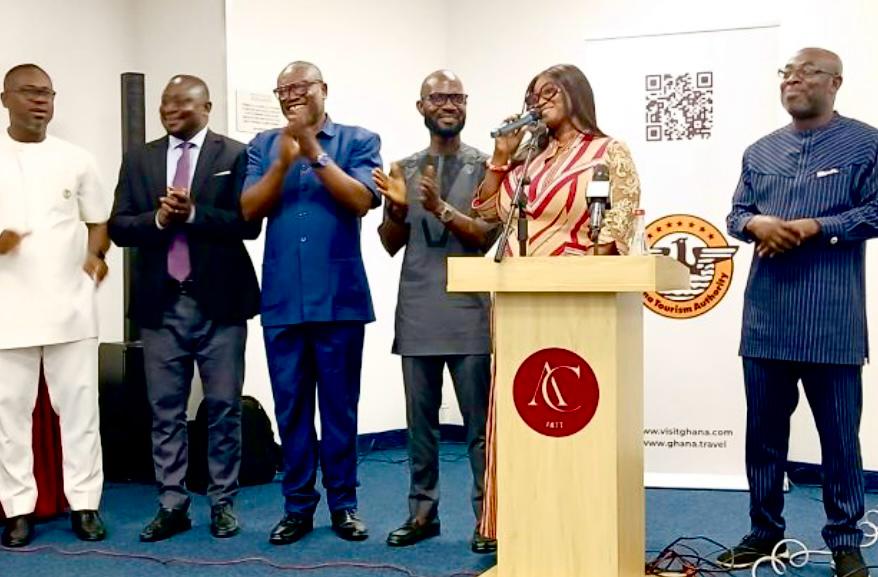
GTA CEO, Maame Efua Houadjeto and her team launch the GTIS last Tuesday
On the surface, it appears administrative. A modernisation of licensing, inspections, registrations, levy payments, and compliance procedures. And yet beneath that administrative language lies something far more consequential. What every tourism system has at its core; a philosophy of movement.
Never just about travel logistics, hotels, attractions, every tourism system reflects deeper ideas about how people move, why they move, where they are encouraged to move, and what kinds of experiences a destination chooses to value and organise around.
In other words, tourism systems are not neutral. They shape human movement intentionally, and create a “philosophy of movement” because they ask questions like:
- What kinds of journeys matter?
- Which places are made visible and accessible?
- Which communities are connected to economic flows?
- What experiences are considered valuable?
- Is travel designed for speed, extraction, luxury, pilgrimage, heritage, leisure, learning, or immersion?
- Does movement concentrate wealth in a few urban hubs, or distribute it across landscapes and communities?
These were some of the questions Isaac Paul Allotey, leading his team at Pidasmo Technologies Group, the Ghanaian-based tech development company he founded, which built the system, says they queried in order to arrive the product they eventually produced. PaJohn Dadson asked Issac to spell out how we got here.

The brains behind Pidasmo Technologies Group, the Ghanaian based tech company that built the Ghana Tourism Authority’s recently launched Ghana Tourism Information System (GTIS) – From L-R: Jerry Asamoah, COO; Isaac Paul Allotey, CEO; and Collins Asabre, CFO.
In tourism economies, trust is not an abstract virtue. It is infrastructure. It determines where people travel, where investors commit capital, where airlines expand routes, where hotels rise, where events gather momentum, and where local economies become visible enough to participate in national growth. A destination that cannot be trusted digitally eventually becomes invisible economically.

Serenity at Fulla Waterfalls. Photo: @mawuliadjabeng
This is why the emergence of the Ghana Tourism Information System (GTIS) may become one of the most consequential structural developments in Ghana’s tourism evolution, not because it is merely a database, but because it introduces the possibility of something Ghana’s tourism sector has historically lacked: coordinated visibility.
A system that can decipher a cluster focused largely on hotels and airports promotes one “philosophy of movement”; a centralised, transactional, urban, consumption-driven travel. Typically, a MICE destination. And, another that includes cultural trails, oral histories, conservation areas, and community stays would promote another; an immersive, distributed, relationship-centered movement, is not merely software, but a way to quietly help determine:
- what becomes visible
- who participates economically
- how travelers move through Ghana
- and what version of Ghana becomes legible to the world.
This is all so exciting. Something that will generate information, data, in real time. Such a welcome development, this is a milestone for our tourism industry. This GTIS digital instrument that enables tourism operators to seamlessly access licensing and regulatory services, significantly reducing bureaucratic delays and improving compliance processes across the sector. And all that, remotely too!
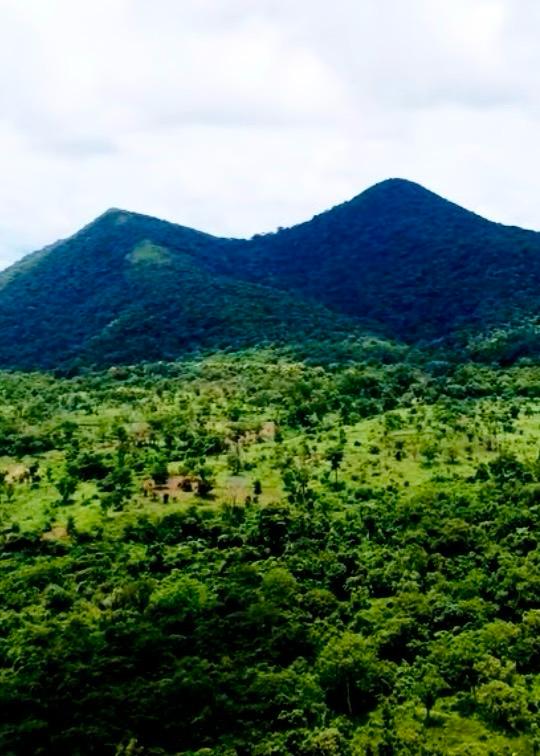
Kyabobo mountains, Oti Region
As technical partners, Isaac and his Pidasmo Group had a simple problem to solve. Build a digital platform to address the four critical operational challenges holding back Ghana’s tourism sector. The four operational gaps which impacts different stakeholders, but together shape the experience of doing tourism business in Ghana.
- Levy Filing & Payments; Filing and payng the tourism levy was opaque, manual, and hard to audit.
- Ease of Facility Registration; Operators face manual, fragmented steps to register and pay for licensing.
- Facility Licence Verification; Guests could not easily confirm that a provider was licensed and compliant.
- License Renewal Tracking; Operators had no visibility into renewal status, deadlines or compliance.
“We responded to the ‘Call for Proposals’ on the GTA website, got invited to make a presentation to the Board. We were selected, apparently, out of eight entries,” recalls Isaac, whose company – with their strong focus on the tourism, hospitality, and fintech ecosystems – seeks to transform the African continent with innovations using software, consumer applications, and digital platforms.
The result is this “product” converging the pressure points into a unified digital backbone for tourism, essentially – for guests, for operators, and for the integrity of the industry.
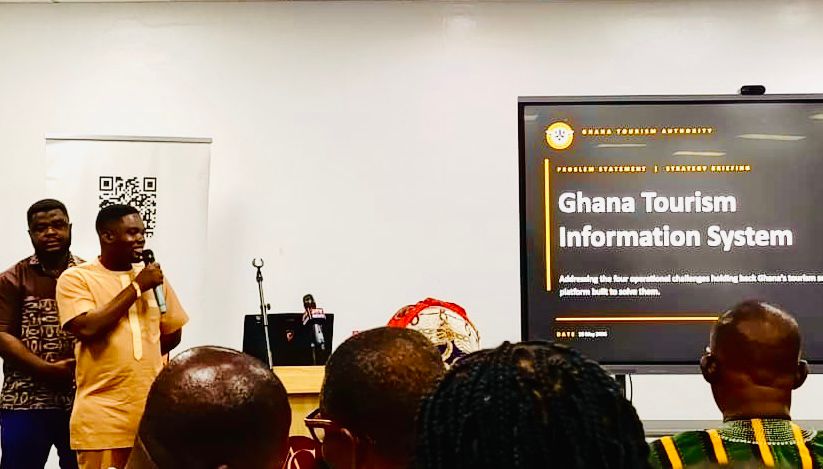
Isaac presents a demonstration of the System
“While we already had a framework developed, it took us three intensive months after winning the bid to fully conceive and bring this solution to life, thanks to the CEO, Maame Efua Houadjeto, who worked with us every step of the way to achieve this. She understood that the future foundation of the Ghana Tourism Authority in this digital era must begin with the right systems.”
“When I assumed office as Chief Executive Officer of the Ghana Tourism Authority, one thing became immediately clear to me: if we truly want to transform tourism into a major pillar of national development, then we must first fix the foundation. And that foundation begins with systems,” Maame Efua Houadjeto said at the official launch.

The GTIS stands at a defining crossroads between merely being a regulatory database, and becoming Ghana’s foundational tourism infrastructure. At its core, the system formalises and digitises Ghana’s tourism economy by registering, verifying, licensing, and mapping tourism enterprises across the country. In doing so, it addresses decades of fragmentation where destinations, operators, and cultural assets existed without visibility, measurable data, or institutional recognition.
But the GTIS is more than an administrative tool; it is an “economy of trust.” Through digital registration and verification, it creates legitimacy, accountability, discoverability, and access to policy, partnerships, promotion, and investment. In tourism, visibility becomes economic survival.
The deeper question is whether GTIS will remain a compliance platform, focused on licensing, levies, and inspections, or evolve into a living tourism intelligence system capable of mapping how tourism actually moves across Ghana. Tourism is fundamentally a movement economy, and when movement is properly mapped, it becomes developmental intelligence.
If expanded thoughtfully, the GTIS could become a national tourism visibility grid connecting accommodation, transport, gastronomy, festivals, heritage, agritourism, conservation, storytelling, and cultural experiences into one ecosystem. Such a system would improve investor confidence, support local development, strengthen destination planning, and make Ghana more structurally legible to both travelers and international partners.

Fun and insightful safari at Mole National Park. @WangoWango
Digital systems, however, risk becoming extractive if they only collect levies and data without visibly reinvesting into the tourism ecosystem. Trust, therefore, must extend beyond verification into much more transparency, reinvestment, and developmental outcomes.
Ultimately, the GTIS is envisioned evolving into far more than software or a registry, but reimagine the national cultural atlas, – a living archive of Ghana’s experiential geography, mapping not only where people stay, but how culture, memory, landscapes, and identity move through the country.
The central argument is that the future of tourism belongs to destinations that combine storytelling with infrastructure, narrative with data, and culture with systems. GTIS, therefore, represents a profound shift: from counting tourism, to understanding it, from managing facilities to mapping culture.
A key feature of the platform is its license verification system, which empowers the public, visitors and tourists, to authenticate registered tourism facilities. This is especially important because it allows people to make informed choices. In every society, there are charlatans, and this platform helps to avoid them.
At last, the industry has a national tourism memory system. A living cartography of movement, culture, commerce, and presence.
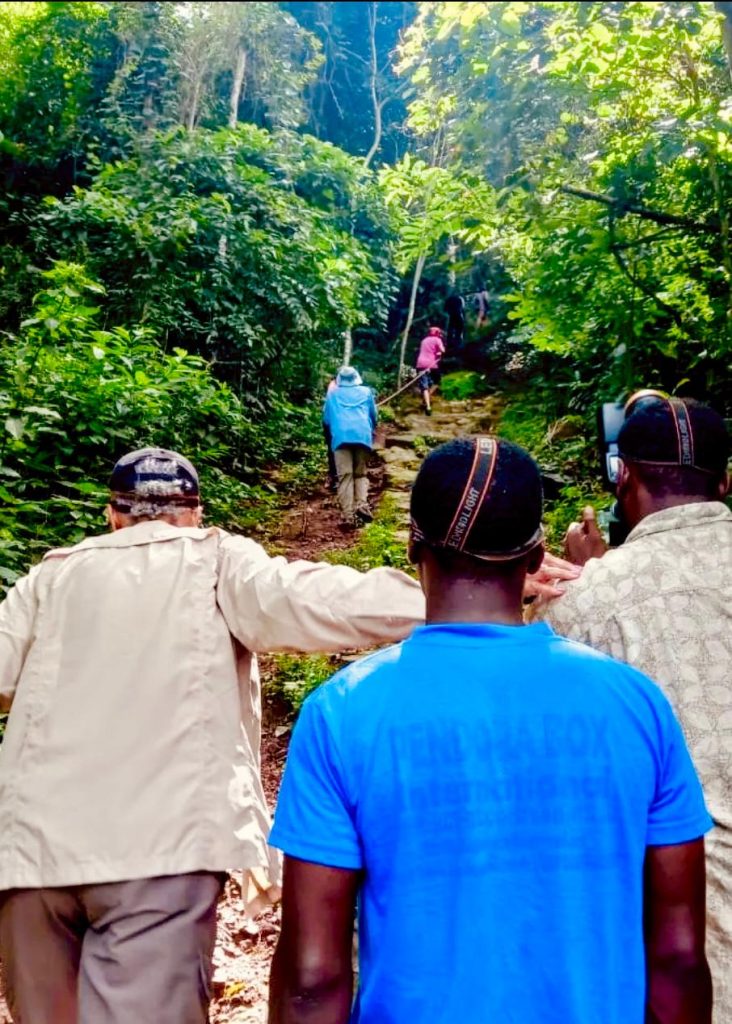
All levels of hiking gradients, even for the elderly. @WangoWango
The GTIS must succeed, and finally transition Ghana’s tourism sector from scattered activity into a coordinated tourism economy.
An economy where visibility creates participation, and therefore, trust. An economy where trust becomes infrastructure.
“Tourism is not just about leisure. Tourism is business. Tourism is employment. Tourism is culture. Tourism is investment. Tourism is national identity,” emphasised Maame Efua Houadjeto.
The real stakes of this conversation, is actually not software, nor registration.
It is whether Ghana is finally prepared to build tourism as a system, rather than merely experiencing it as scattered moments of attraction.
-END-
Search
Archives