

Ghanaian businesses encouraged to explore opportunities in the carbon market
Ghanaian businesses encouraged to explore opportunities in the carbon market
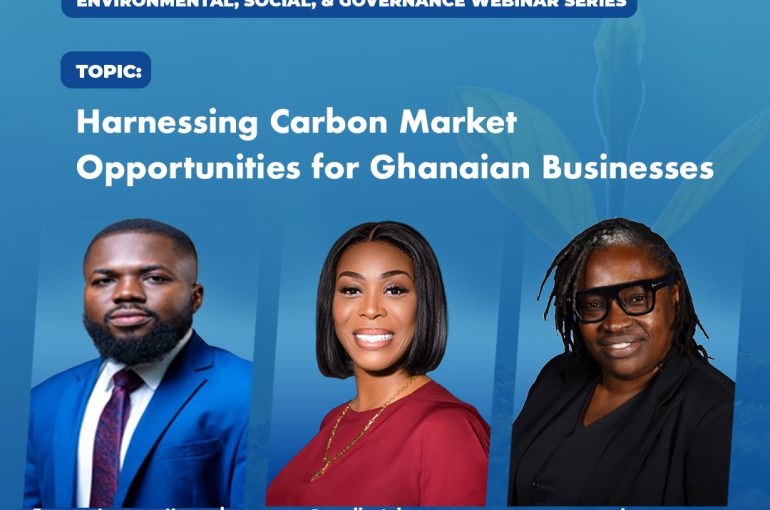
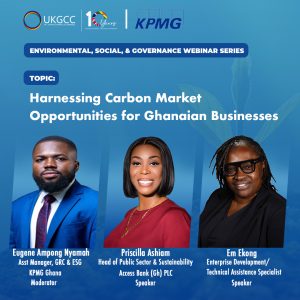
Ghanaian businesses, particularly small and medium-sized enterprises (SMEs), are being encouraged to explore opportunities in the growing carbon market. Experts say credible carbon-related activities could provide businesses with additional revenue streams.
This revenue can be generated by converting verified greenhouse gas emission reductions, removals or avoided emissions into carbon credits. The credits may then be sold to companies seeking to meet voluntary climate commitments, carbon market intermediaries or authorised buyers under international carbon market mechanisms.
Speaking during a webinar organised by the UK-Ghana Chamber of Commerce (UKGCC) and KPMG Ghana on the theme “Harnessing Carbon Market Opportunities for Ghanaian Businesses”, Priscilla Ashiam, Head of Public Sector and Sustainability at Access Bank Ghana, explained that carbon credits can create an additional revenue stream when the underlying environmental performance is credibly assessed and verified.
She noted that verified and measurable environmental performance, including emissions reduced or avoided, can be monetised through carbon credits.
Carbon markets and Ghana’s emerging opportunities
According to the United Nations Development Programme, carbon markets are trading systems through which carbon credits are bought and sold. Each credit represents one tonne of carbon dioxide, or the equivalent amount of another greenhouse gas, reduced, avoided or removed from the atmosphere.
Article 6 of the Paris Agreement provides a framework for countries to cooperate in meeting their climate targets. This creates potential opportunities for Ghanaian SMEs to access climate finance and build international partnerships, provided they meet applicable regulatory requirements and demonstrate environmental integrity.
Ghana is positioning itself to participate in international carbon markets and attract climate finance.
Carbon readiness requires more than awareness
Em Ekong, an enterprise development and technical assistance specialist, highlighted the distinction between understanding carbon markets and being ready to participate in them.
She explained that businesses may understand carbon markets, carbon credits and the associated commercial opportunities, but knowledge alone is insufficient. The key, she noted, is converting that knowledge into a credible, investment-ready opportunity.
Drawing on her experience in the carbon market, she emphasised the importance of coaching and specialist support in helping SMEs become both investor-ready and carbon-ready.
“Having an environmentally positive business does not mean that you are carbon-ready,” she said, noting that some businesses may already be undertaking environmentally beneficial activities but lack the knowledge and systems required to access carbon market opportunities.
Developing bankable carbon projects
Research indicates that SMEs face significant challenges in accessing bank finance for carbon projects. In response, Ashiam explained that businesses could improve their prospects of securing financing by demonstrating both a strong underlying business case and a credible carbon component.
She noted that financiers consider factors such as commercial viability, the credibility of the carbon project, baseline setting, additionality, monitoring and verification arrangements, regulatory approvals, ownership and the business’s capacity to execute the project.
Technical assistance can help SMEs address some of these gaps. Ekong noted that expert coaching and technical support may be required to develop viable carbon opportunities and prepare credible investment cases.
Drawing on her recent experience as a technical assistance team lead for the ShEquity Gender-Smart Technical Assistance Facility in Ghana, Ekong underscored the value of structured support: “The technical assistance facility is essential to take businesses through that phased approach.”
Why businesses should start preparing now
The panellists highlighted opportunities across sectors including agriculture, forestry, energy, transport and waste management, as well as enabling services and technologies such as data capture, analytics, monitoring and assurance. However, they cautioned that developing credible carbon projects requires significant investment in time, expertise and resources.
“Something like this will take you over a year to develop good projects for the carbon market,” Ekong said.
Ashiam therefore encouraged Ghanaian businesses to begin preparing before the market fully matures. She explained that early engagement would give financial institutions a better opportunity to understand and support emerging projects.
She also advised businesses not to regard carbon credits as “free money”, stressing that the environmental performance underpinning each credit must be credible and verifiable.
Moderated by Eugene Ampong Nyamah, Manager, ESG Advisory and Risk & Compliance Services at KPMG Ghana, the webinar also explored investment and carbon readiness, data and measurement, sector opportunities, and gender-related barriers to accessing capital and participating in carbon markets, particularly for women-led businesses.