

REAC urges stakeholders to comply with Act or face sanctions
The Real Estate Agency Council (REAC) has urged real estate practitioners, developers, brokers, agents, and other industry stakeholders in Ghana’s real estate sector to comply with the Real Estate Agency Act, 2020 (Act 1047), cautioning that breaches could attract administrative sanctions, licence suspension or revocation, and criminal penalties.
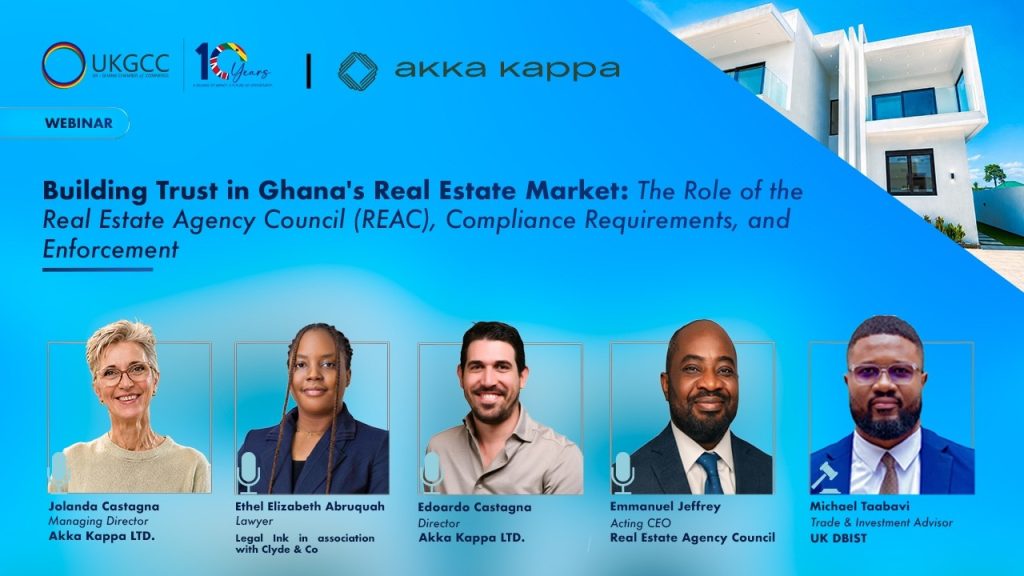
Speaking during a UK-Ghana Chamber of Commerce and Akka Kappa Ghana LTD. webinar on “Building Trust in Ghana’s Real Estate Market: The Role of the Real Estate Agency Council (REAC), Compliance Requirements, and Enforcement”, the Head of Anti-Money Laundering and Compliance at REAC, David Pappoe, explained that administrative sanctions included a fine of 1,000 penalty units, which he put at GH¢12,000, for such breaches as failing to comply with requirements or display a certificate or licence in an office.
For criminal offences such as operating or advertising without a license, falsifying documents, and accepting cash payments, Mr. Pappoe said the penalties ranged from 5,000 to 10,000 penalty units or five to 10 years’ imprisonment.
“Section 22 says that no person must provide real estate services as a broker or agent, or engage in any transaction without a license from REAC. So, that means when you operate without a license, it’s a criminal offense”, Mr. Pappoe remarked.
He added, “It is a cashless sector now for real estate. Not even GHS1 must be taken in the form of cash…When you accept cash, then it means you are in breach of the Act”.
He, therefore, urged members of the public to verify the licence status of real estate practitioners before engaging them, and to report suspicious/cash transactions to the Financial Intelligence Centre (FIC) and issues involving clients, developers, brokers, or agents to REAC.
Understanding Act 1047 and REAC’s regulatory mandate
Mr. Pappoe explained that Parliament enacted the Real Estate Agency Act, 2020 (Act 1047) to regulate real estate practice and commercial real estate transactions, including the sale, purchase, rental and leasing of property. The law also established REAC as the statutory regulator of the sector.
He said the council’s mandate includes licensing and registering practitioners, maintaining a national register of real estate operators, publishing lists of licensed practitioners in good standing, setting professional standards, inspecting premises, and enforcing discipline across the industry.
The Act regulates developers, brokerage firms, brokers, agents, property managers, marketers, salespersons and any individual providing real estate services.
On compliance obligations, he stated that all practitioners must use REAC-issued forms, maintain a cashless operating environment, keep separate client accounts, preserve records for at least five years, submit quarterly transaction reports and annual audited accounts, and obtain professional indemnity cover.
Support from industry stakeholders
A lawyer at Legal Ink in association with Clyde & Co, Ethel Elizabeth Abruquah, agreed that stronger regulation is critical to improving confidence in Ghana’s property market and protecting buyers from fraudulent transactions. She encouraged prospective property purchasers to retain lawyers and undertake extensive due diligence before committing funds.
“Before committing to acquiring property in Ghana, it is very important to make your own independent verifications,” she said, adding that buyers should verify ownership, conduct searches at the Lands Commission, and undertake additional checks where necessary.
On anti-money laundering obligations, she explained that brokers, agents and lawyers are designated accountable institutions under Ghana’s anti-money laundering framework and must report suspicious transactions, conduct customer verification and comply with record-keeping requirements.
For his part, Director of Akka Kappa LTD., Edoardo Castagna, remarked that “The introduction of REAC has been extremely important,” describing it as a major step towards professionalising the industry. He said the Council was helping to establish baseline standards, introduce accountability, and distinguish licensed professionals from informal operators.
Mr. Castagna, however, noted that trust challenges- a major issue in the property market, often stem from information asymmetry, difficulties verifying property ownership, and the continued presence of informal operators.
He was optimistic that greater public awareness of REAC’s role would help sanitise the sector and improve confidence among investors, buyers and tenants.
The two panellists urged the public to undertake proper due diligence, work only with licensed practitioners and make use of available legal and regulatory channels when concerns arise.
From regulation to implementation
The Acting Chief Executive Officer of REAC, Emmanuel Jeffrey, said the Council was working to strengthen implementation of the Act through licensing, collaboration with other institutions, public education, and increased regulatory oversight.
He identified licensing as a key priority because it enabled the Council to establish a database of people operating in the sector.
“The most important thing for me is the licensing,” he said, explaining that the objective was to ensure that everyone practising real estate in the country was registered and that the Council had data on practitioners.
Mr. Jeffrey also highlighted the Council’s collaboration with institutions including the Financial Intelligence Centre (FIC), Bank of Ghana, Lands Commission, Ghana Revenue Authority and other stakeholders to ensure compliance with the Act.
“We don’t work in isolation. We work in collaboration with institutional bodies to ensure the right thing is done”.
The Council is also taking steps to address unregistered operators advertising properties, as well as working with assemblies and other stakeholders on measures to ensure compliance with the Act.
Mr. Jeffrey assured the public that the Council will continue its sensitisation efforts to promote awareness of the Real Estate Act, and entreated the public to engage with only REAC-licensed agents, brokers, and developers.
The webinar, moderated by Michael Taabavi, Trade and Investment Advisor for Infrastructure and Energy at the UK Department for Business, Innovation, Science and Trade, also explored how practitioners can obtain REAC licences, the different licensing routes and requirements; Ghana’s Anti-Money Laundering Act and its relationship with the Real Estate Act; and the Council’s code of conduct and ethics.
Search
Archives