

Investors increasingly using ESG to shape investment decisions in Africa
Investors increasingly using ESG to shape investment decisions in Africa
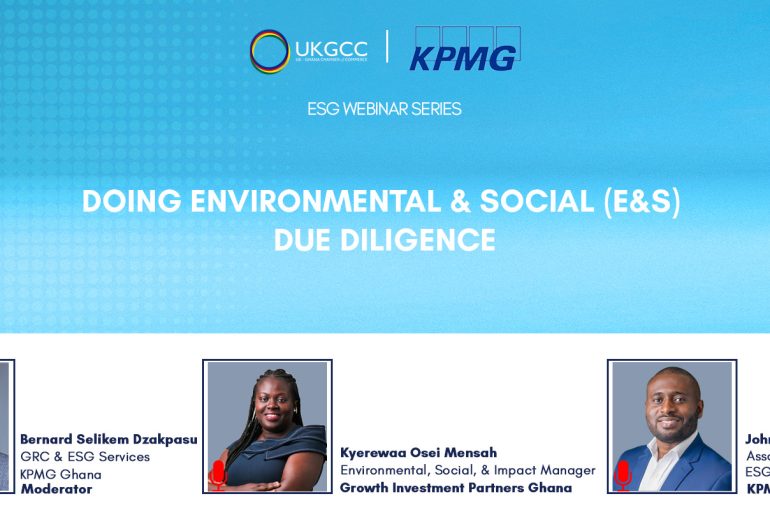

Environmental, Social and Governance (ESG) considerations are increasingly shaping how capital is deployed across Africa, with investors looking beyond compliance to assess both risk exposure and long-term value creation opportunities.
This emerged during a webinar hosted by the UK-Ghana Chamber of Commerce (UKGCC) in partnership with KPMG Ghana on the topic “Doing Environmental & Social (E&S) Due Diligence.” Panellists explained that E&S Due Diligence is no longer viewed merely as a compliance requirement, but as a strategic tool for evaluating investment viability, strengthening governance, and improving sustainability performance. Speaking during the session, Kyerewaa Osei Mensah, Environmental, Social, and Impact Manager, Growth Investment Partners (GIP) Ghana, noted that E&S due diligence now plays a vital role in how investment decisions are made.
Environmental and Social Due Diligence is non-negotiable for us and forms the basis on which investment decisions are taken,” she stated.
She cautioned against treating due diligence as a superficial “box-ticking exercise,” explaining that weak ESG processes often result in critical risks being overlooked until much later in the investment lifecycle.
According to her, risks ignored during due diligence can eventually manifest in the form of high non-Performing loans (NPLs), operational disruptions, reputational damage, and weakened stakeholder trust.
The discussion highlighted a broader shift within Africa’s investment ecosystem, where investors are becoming increasingly deliberate about ensuring that projects and businesses meet acceptable E&S standards before capital is deployed.
John Akuoko-Tawiah, Associate Director, ESG Services, KPMG Nigeria, explained that investors and financial institutions are increasingly integrating ESG considerations into capital allocation and financing structures across Africa.
According to him, sustainable finance is evolving beyond policy commitments into a core investment consideration, with lenders and investors placing greater emphasis on environmental and social risk management, governance systems, climate resilience, and measurable impact outcomes.
He noted that ESG considerations are now influencing how institutions structure financing instruments, assess long-term project viability, and demonstrate additionality within investment portfolios.
Moderating the session, Bernard Selikem Dzakpasu, Sustainability & ESG Services Manager at KPMG Ghana, observed that ESG considerations are increasingly influencing both business operations and investment thinking across the continent.
“The growing presence of ESG in Africa is influencing the way we think and ultimately the way we conduct our business,” he noted.
The session also explored the practical processes involved in Environmental & Social Due Diligence, including project screening, risk categorisation, stakeholder engagement, site assessments, and the application of international frameworks such as the IFC Performance Standards. Panellists explained that robust due diligence processes help organisations identify material risks early, strengthen governance systems, and improve long-term project sustainability.
Driving accountability and measurable impact
As ESG becomes more central to investment decision-making, panellists noted that investors are increasingly focused on measurable impact and accountability.
John Akuoko-Tawiah, Associate Director, ESG Services, KPMG Nigeria, explained that investors are now seeking evidence of additionality and demonstrable impact from the businesses and projects they support.
“Investors are increasingly asking how they can demonstrate that their investments are creating measurable impact and additionality beyond financial returns,” he stated.
He added that investors are increasingly expected to demonstrate not only financial returns, but also how investments contribute to sustainable development outcomes across communities and sectors.
Akuoko-Tawiah further highlighted the importance of shared value creation between investors and businesses, stressing that ESG should be approached collaboratively rather than a compliance burden.
“We can go on the journey together so that the impact created becomes a shared impact.” he added.
The webinar also examined how E&S Due Diligence findings influence investment structuring, post-investment monitoring, and long-term operational performance. Panellists noted that ESG considerations now affect not only risk assessments but also financing terms, governance expectations, corrective action plans, and ongoing monitoring frameworks.
ESG as a continuous and collaborative process
Osei Mensah further emphasised that E&S due diligence should not be treated as a one-off activity conducted only before investment decisions are made.
According to her, continuous monitoring and periodic reviews are necessary to ensure that agreed environmental and social controls are implemented effectively after funds are disbursed.
“It should be an ongoing process. After GIP disburses funds, we carry out annual audits to ensure that systems are being implemented,” she explained.
She also encouraged organisations to approach E&S Due Diligence as a collaborative value-creation exercise rather than a policing mechanism.
“Let us treat E&S Due Diligence as a collaborative process, by working with companies to strengthen their Environmental and Social Management Systems (ESMS) and demonstrate the value proposition beyond compliance,” she stated.
Overall, the webinar reinforced that ESG is no longer a peripheral consideration but an increasingly important determinant of how capital is allocated across Africa. As investor scrutiny continues to rise, organisations that can demonstrate credible E&S performance, strong governance systems, and measurable impact will be better positioned to attract sustainable investment and remain competitive in an evolving global economy.