

Bentsifi’s Tattle…Guy about town
From dialogue to deals – On West Africa MICE Roundtable, Bentsifi urges value-driven shift in tourism
Like the rest of the world has seen before, Africa’s tourism is undergoing a transition, from leisure-driven travel to business-led convening. All those passive visitations are becoming active participatory events, connection, and investment boosts. Accelerating tourism’s evolution into a MICE-driven economy, where every journey is a corridor for meetings, incentives, conferences, exhibitions and enterprise is the way forward for the future.
Let’s be clear. People are fed up with talk-shops. Across the continent, people are no longer gathering just to discuss tourism, they are gathering because something needs to move.
For a long time, tourism has been treated as just leisure. As escape, an experience. But that frame is no longer enough. Because a shift is already happening. A quiet one, but it is decisive. And that shift is moving us from tourism as leisure… to tourism as leverage.
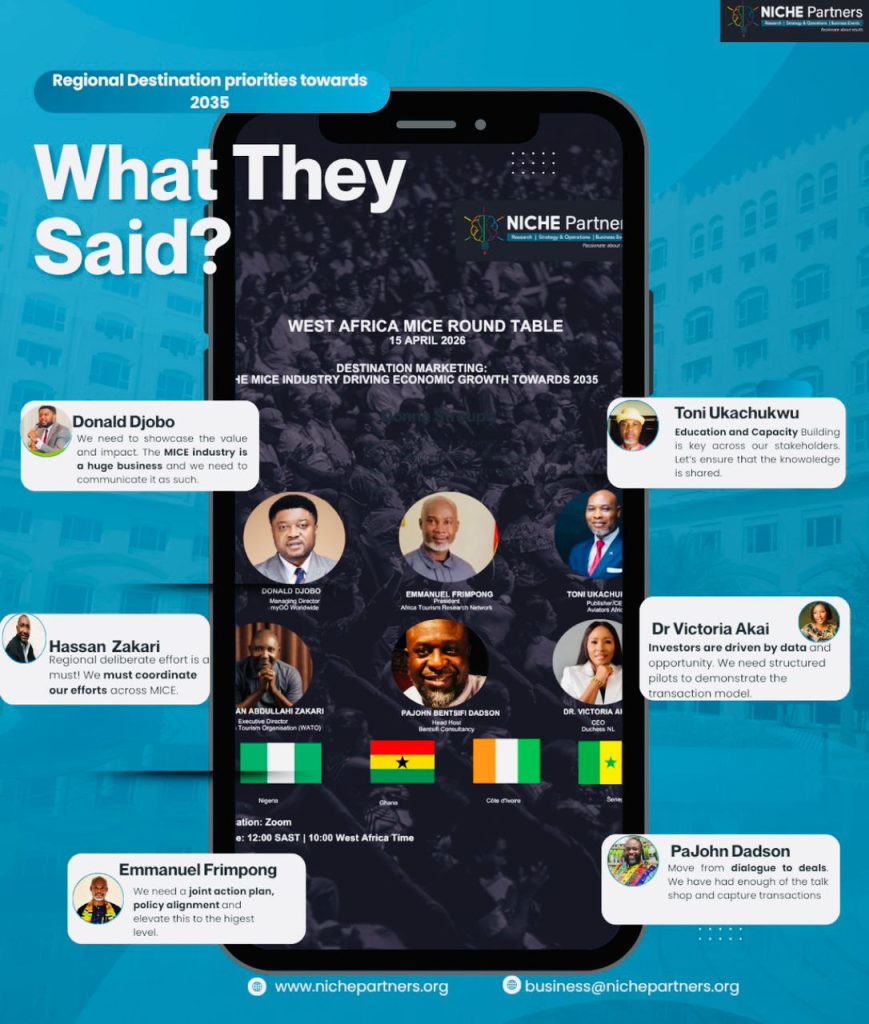
That seems to have been the general consensus which emerged when leading researchers in Africa’s MICE industry, Niche Partners of South Africa, hosted an online panel focused on West Africa on the theme “Destination Marketing: The MICE Industry Driving Economic Growth Towards 2035’. Londi Khumalo is the Chief Business Development Officer at Niche Partners and the moderator for the West Africa Business Events Roundtable which took place on Zoom on Wednesday, 15 April.
Connecting with Africa’s MICE (Meetings, Incentives, Conference and Exhibitions) industry, she follows the community’s perspectives and trends keenly and wants to find out the key things needed to champion in order to get African governments to better understand, align and support their MICE sectors to drive tourism growth. PaJohn Bentsifi Dadson sums up what transpired.
It is a fact that travel is no longer just about where you go, but about what becomes possible because you went. Presence is no longer passive, but participatory; and destinations are not endpoints, but entry points into opportunity.
With an assembly of crack industry experts from West Africa, including Côte d’Ivoire’s Donald Djobo of MyGo Worldwide; Nigeria’s Hassan Abdullahi Zakari – Executive Director, West Africa Tourism Organisation (WATO); Dr. Victoria Akai of ECOWAS Parliament & Director-General of Abuja Chamber of Commerce & Industry; and Toni Ukachukeu – CEO of Aviation Africa, alongside Ghana’s Emmanuel Frimpong – President of Africa Tourism Research Network; and yours truly, as Principal of Do Ghana Travel Advocacy & former pioneer Lead at GTA’s MICE division, there was consensus that it was time to decisively “move from dialogue to deals”.
Dr. Victoria Akai put it more succinctly. “Prioritising the MICE industry, which constitutes business events, must be viewed as an investment that African governments can no longer afford to ignore, but take particular steps to structure and develop.”
This is where the tension lies because while the traveller has evolved, many of Africa’s travel platforms have not. Particularly in countries where there is no political will.
Working in silos, government and the private sector are still designing for conversation in moments that demand conversion. Still hosting events, when they should be engineering deal environments.
“We are still measuring attendance, when we should be measuring outcomes, results,” amplifies Africa Tourism Research Network President, Emmanuel Frimpong, who believes that data is the currency that determines investment decisions, and the future of what Africa can attract through tourism.
“Data is the heartbeat of investment,” reiterates Aviation Africa’s Toni Ukachukeu, “and the events that MICE attracts are strategic economic tools which we need to be aligned and coordinated for maximum impact.
Londi agrees, and thinks that the “fragmentation” of the industry needs serious attention and leadership to make sure they can deliver the next frontier.
A cursory glance at the MICE ecosystem in the region shows a 12 percent annual growth, “with increasing demand in emerging destinations,” contends Executive Director of West Africa Tourism Organisation (WATO), Hassan Abdullahi Zakari. However, with data collation and strategies fragmented, Hassan says “now, more than ever before, the region has to begin thinking about collaborations, developing partnerships, and make manifest a ‘West Africa Tourism Council’ to lead in strengthening the region’s efforts.”
Extolling the MICE DNA of Côte d’Ivoire, for example, Donald Djobo points to similar features you might find in other West African countries like Nigeria and Ghana. The only difference might be that perhaps, the Ivorian Government and sector is more aligned with its strategic objectives than the others. There is political will. The challenge, Djabo argues, is that though the country is MICE-ready, having recently hosted a 4000-capacity event seamlessly, not being English-speaking is a drawback for them increasing the frequency of events that could be attracted.
In December, for instance, both Lagos and Accra each attract an influx of diaspora visitors who come for the Christmas festivities and parties. The aggregate numbers that show up are indeed of significant impact. However, in all this, there are no coordinated measures that show collated growth for investors to make informed decisions about investing in these markets. Much of what is available is social media hyperbole, which is largely based on subjective rhetoric rather than relevant objective data.
People will still come. The only question is; will anything move because they did?”
Right now, much of the continent is still convening panel-heavy, insight-rich conversations about “potential”. The opportunity is to become the ones who engineer transaction environments. And, let’s be clear: moving from dialogue to deals in Africa’s MICE space isn’t just a shift in language, it’s a shift in posture, structure and power. And governments need to pave the way.
In conclusion, the panelists noted that to achieve economic growth toward 2035, tourism events need to become less of a “talk shop”, and be architected more as a ‘marketplace’, with pre-matched participants (not open attendance). There must be clear “who needs what” mapping before arrivals, with structured deal rooms, and not just networking cocktails.
Negotiations should have time-bound windows, thinking less “conference agenda” and more private capital convening.
Only then will the question move from: “How do we attract more visitors?” – to “What moves because they came?” That is the shift. That is the opportunity. That is the responsibility!
Fin
Search
Archives