

SMEs urged to take ownership of ESG action plans to strengthen investment readiness
SMEs urged to take ownership of ESG action plans to strengthen investment readiness
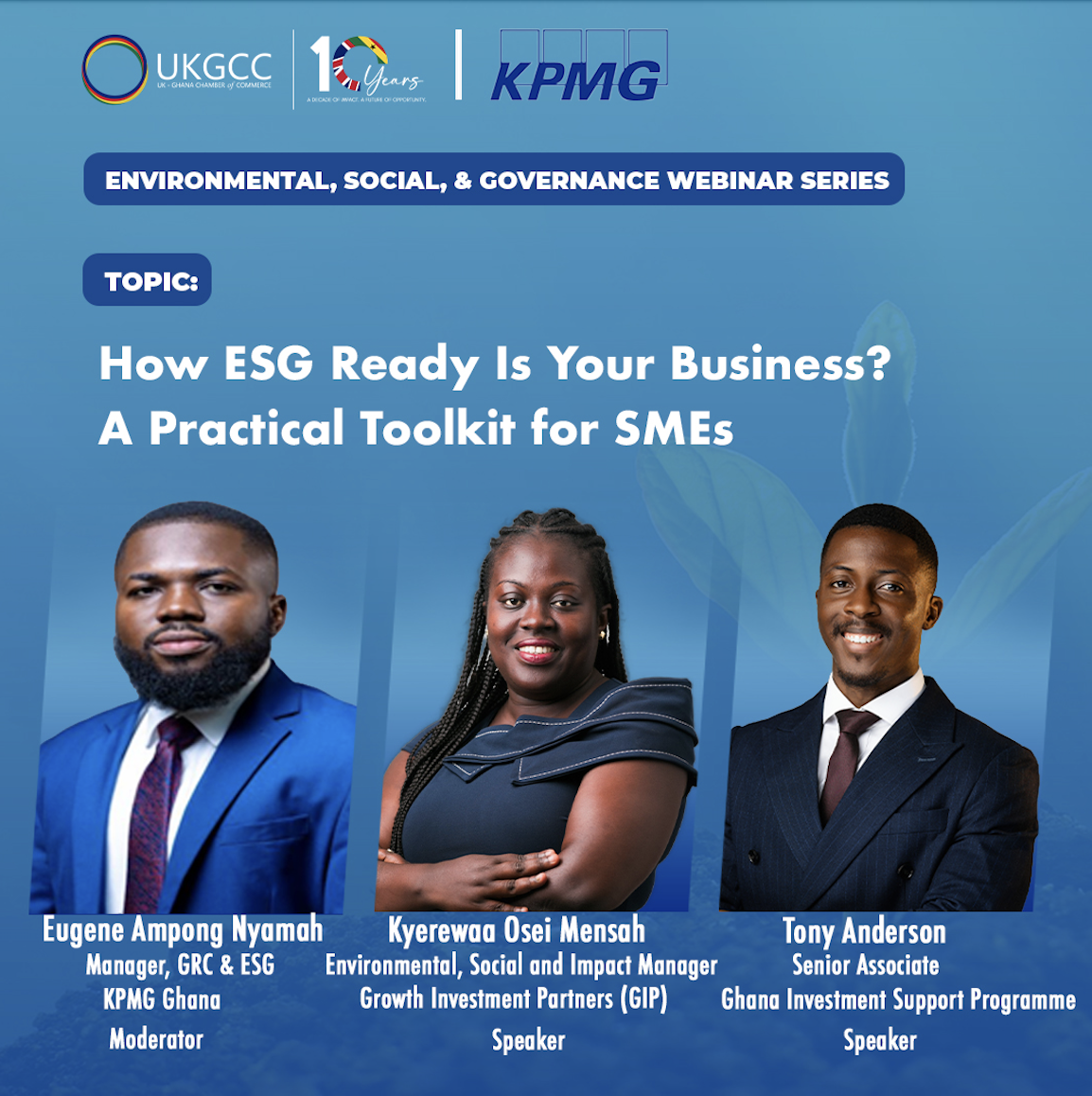
Small and medium-sized enterprises (SMEs) have been encouraged to take greater ownership of their environmental, social and governance (ESG) practices by assessing their existing systems, identifying gaps and developing action plans to address them.
Strengthening these practices can help businesses better understand and meet investor requirements while building more resilient operations. However, this requires businesses to move beyond simply having ESG policies in place to ensuring that they are implemented, communicated to employees and supported by clear responsibilities and regular reviews.
Speaking during a webinar organised by the UK-Ghana Chamber of Commerce (UKGCC) in collaboration with KPMG Ghana on the theme “How ESG Ready Is Your Business? A Practical Toolkit for SMEs”, Kyerewaa Osei Mensah, Environmental, Social & Impact Manager at Growth Investment Partners (GIP) Ghana, took participants through the ESG Health Check and its assessment approach, highlighting how businesses can use it to evaluate their ESG practices and identify gaps.
The ESG Health Check, a diagnostic tool within the Ghana Investment Support Programme’s (GhISP) ESG Toolkit, provides businesses with a practical starting point for assessing their ESG practices and identifying areas that require improvement.
“The health check helps businesses understand what needs to be done, and the plans and resources required to address identified gaps,” Osei Mensah explained.
Taking ownership of ESG action plans
Osei Mensah explained that identifying ESG gaps is only the starting point. Businesses must translate assessment findings into practical action plans, assign responsibilities and ensure that management regularly reviews progress. GhISP’s accompanying Environmental and Social Management System (ESMS) Manual Template helps guide companies through that process.
“You would need to put the required actions into a manual, assign specific responsibilities within the organisation on who is taking what action,” she noted, adding that senior management should receive monthly or quarterly updates on the progress of these plans
She further highlighted the importance of involving employees and other relevant stakeholders in the assessment process, noting that business owners and managers may not have all the information required to complete an assessment independently.
The ESG Health Check assessment covers several areas, including labour and working conditions, contracts, workers’ remuneration, environmental permits, whistleblowing mechanisms, anti-bribery policies and the management of gifts, environmental management, occupational health and safety, stakeholder engagement, and corporate governance and business integrity.
Supporting SMEs to become investment-ready through GhISP
Providing further context on GhISP and the development of the ESG Toolkit, Tony Anderson, Senior Associate at GhISP, said the programme is a technical assistance initiative established to increase investment flows to underserved SMEs in Ghana.
Anderson explained that businesses often face challenges accessing finance, while fund managers and investors can find it difficult to identify businesses that meet their investment requirements.
Through capacity building, technical assistance, training and access to resources, GhISP supports businesses to strengthen their operations and improve their investment readiness.
Anderson explained that the ESG Toolkit was developed in response to the challenges SMEs face in understanding and implementing ESG practices including limited knowledge of ESG requirements, a lack of in-house expertise, the cost of engaging external consultants and inadequate documentation.
The toolkit comprises three main resources: an online ESG Health Check – which Osei-Mensah took webinar participants through, a downloadable Excel assessment tool and an Environmental and Social Management System (ESMS) Manual.
Anderson recommended that businesses begin with the online Health Check, use the downloadable Excel tool where they require a more detailed assessment, and refer to the ESMS Manual for guidance on addressing the gaps identified.
He added that upon completing each pillar of the assessment, businesses can view compliance roadmaps and action plans outlining the areas they need to address.
Anderson, however, cautioned SMEs against treating the assessment as an examination in which they must achieve a high score as it is purely a diagnostic tool.
“The Health Check Tool is a diagnostic tool, so do not approach it as an exam or try to score 90% or 100%.”
Technical assistance in practice
To illustrate how technical assistance can support business growth, Anderson shared the experience of Springs and Bolts, a Kumasi-based manufacturer of leaf bolts and springs for heavy-duty vehicles.
GhISP provided support to address gaps in the company’s ESG practices and the business subsequently received funding, enabling it to expand into a larger warehouse, increase production and explore other markets.
During the webinar, both speakers emphasised that ESG assessments should be treated as an ongoing process rather than a one-time exercise. Businesses were encouraged to regularly review their systems and policies, track progress and reassess their practices as their operations evolve.
As Anderson explained, “The whole reason for the tool is to be able to move from compliance to value creation.”
Moderated by Eugene Ampong Nyamah, Manager, ESG Advisory and Risk & Compliance Services at KPMG Ghana, the webinar also explored the ESG assessment process, the role of technical assistance in strengthening investment readiness, and opportunities for financial institutions to collaborate with GhISP on ESG capacity building.