

SMEs challenged to prioritise bankability to attract the right funding
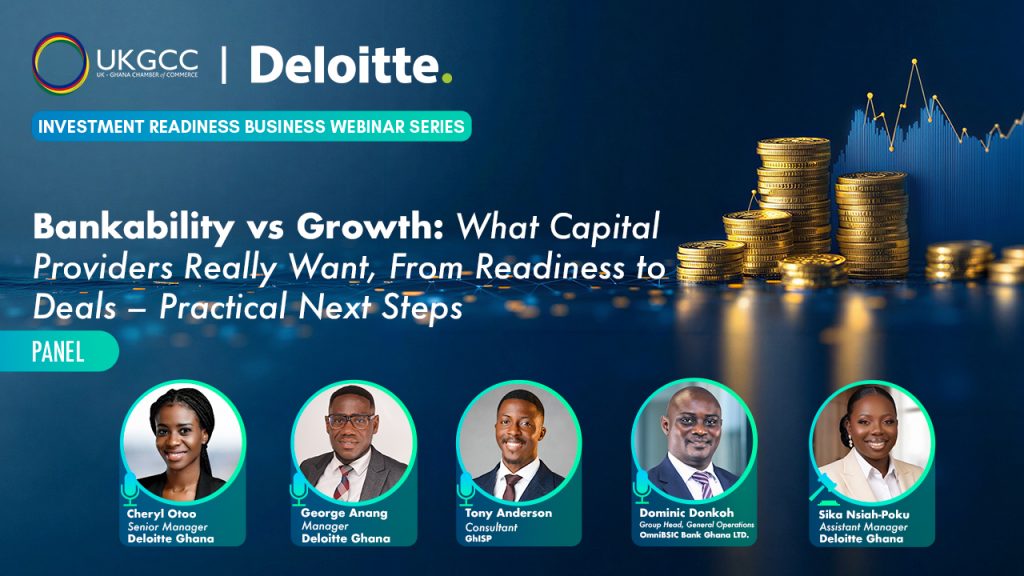
A Senior Manager at Deloitte Ghana, Cheryl Otoo, has challenged Small and Medium-sized Enterprises (SMEs) to look beyond business growth and prioritise bankability if they are to attract the right sources of funding.
Cheryl Otoo said although growth demonstrated that a business was creating value, it did not, on its own, give lenders and investors sufficient confidence to commit capital.
A bankable business is, therefore, one that is ready to attract funding, with credible financial records, the right management team, appropriate governance structures, documented risk management systems, a clear strategy, and evidence of market traction.
According to her, “growth demonstrates opportunity while bankability attracts capital”.
Ms. Otoo made this assertion during an Investment Readiness Series webinar organised by the UK-Ghana Chamber of Commerce (UKGCC) in partnership with Deloitte Ghana, on the theme: “Bankability vs Growth: What Capital Providers Really Want, From Readiness to Deals – Practical Next Steps.”
She identified credible financials, governance, risk management, strategy, market access and market traction as key elements of bankability.
George Ephraim Afotey Anang, Manager, Infrastructure and Capital Projects at Deloitte Ghana and a panelist, concurred with Ms. Otoo, adding that growth was essentially about the rate at which a company created value through revenue, profits, customers, assets, or market share, while bankability was about whether investors and lenders had confidence that the value being created could be delivered and protected.
Tony Anderson, an investment and economic development professional supporting investment activities through the Ghana Investment Support Programme, similarly highlighted the importance of bankability as the main draw for attracting capital.
“Fund managers, private equity, and venture capitalists raise money from what we call a limited partner, promising them returns and reducing their risk by investing in good businesses. So, if you are not documented, if you don’t show the structure that Cheryl mentioned, that raises some concerns.”
Dominic Donkoh, Group Head, General Operations at OmniBSIC Bank Ghana LTD., reinforced the point from the banking perspective, saying banks had liquidity and were willing to lend to businesses that demonstrated bankability.
“Banks have a lot of liquidity, and OmniBSIC has a lot of liquidity, and so very willing to lend to bankable businesses,” he said.
He added that the ideal business to finance was “one that is bankable and is also growing”, and urged SMEs to maintain consistent documentation, manage their cashflows, concentrate on building one business at a time, and put structures in place to ensure good governance.
“The weaknesses in financial records and cash flow challenges is a function of governance. Because if you have the right board that has the right expertise that is holding the management accountable, even if they are the owners, then one would expect that such inconsistencies will not happen”.
From informal records to investment readiness. What SMEs can do now
According to Mr. Anang, “Companies that successfully raise capital actually start preparing a year to two years ahead of engaging a financier”. He recommended that businesses undertake an investment readiness assessment as an initial step and understand the requirements of prospective financiers before beginning the fundraising process.
However, noting that some of these SMEs may not have the financial muscle to seek professional assistance from the onset, the panel identified several practical steps they can establish in their businesses now, to demonstrate the required level of readiness to attract capital.
These included formalising their operations by ensuring strong bookkeeping, putting in place strong operational and financial controls, adequate governance, and less dependence on founders, and tax compliance.
Peter Charway, a Senior Manager in Infrastructure, Capital and Real Estate Projects at Deloitte Ghana, also encouraged SMEs to institute an independent evaluation of their business to align their growth projections with their business realities at all time.
The $4.8bn question: Why the SME funding gap remains
The discussions also drew attention to the persistent financing gap confronting Ghanaian SMEs.
Ms. Otoo said Ghana’s annual estimated SME financing gap stood at $4.8 billion, while formal SME financing across Africa was estimated at between $300 billion to $331 billion.
She said access to capital was often identified as the principal challenge facing SMEs, but conversations with banks and investors pointed to deeper structural issues contributing to the gap.
This financing challenge also persists despite improvements in Ghana’s macroeconomic indicators, which have not automatically translated into easier access to capital for individual businesses.
“Investors and funders are still very careful. They remain cautious because despite the macroeconomic growth or strength of an economy or country, each funding case is seen on a case-by-case basis,” she said.
She, therefore, urged businesses to strengthen their financial management systems, governance, transparency and risk management.
Capital exists but ideas no not attract capital; structure does
Cheryl Otoo shared that the government, through the Bank of Ghana, was seeking to leverage growing digital transaction data to develop solutions to bridge the SME financing gap.
She said development finance institutions were also providing opportunities, citing approximately $300 million deployed by the World Bank in 2025 to support businesses in Ghana and about $75 million committed and deployed by the African Development Bank to support youth, businesses and women-owned businesses, with an intended 30,000 jobs.
She said the opportunities were significant, but SMEs had to improve their preparedness to access them.
“If we can get our act together as small businesses, we can access them,” she said.
The webinar, moderated by Sika Nsiah-Poku, Assistant Manager with Deloitte’s Strategy and Transactions Practice, also examined the role of ESG, governance and independent boards in building investor confidence; the distinction between debt, equity and development finance; and how SMEs without substantial financial histories could develop credible financial models.
Search
Archives