

Investment readiness, not funding, is the biggest barrier to climate finance for SMEs
Investment readiness, not funding, is the biggest barrier to climate finance for SMEs
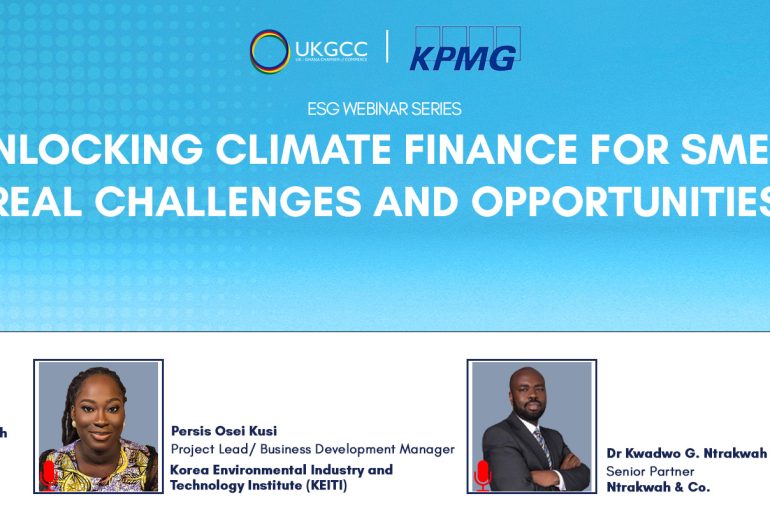
 Investment readiness, rather than the availability of finance, remains one of the biggest barriers preventing small and medium-sized enterprises (SMEs) from accessing climate finance, experts have said.
This emerged during a webinar organised by the UK-Ghana Chamber of Commerce (UKGCC) in partnership with KPMG Ghana, on the topic “Unlocking Climate Finance for SMEs: Real Challenges and Opportunities,” which explored the real challenges and opportunities for SMEs seeking to unlock climate and carbon finance.
The discussion highlighted that while climate finance opportunities, including green loans, grants, equity investments, carbon markets and blended financing, continue to grow, many SMEs struggle to access these opportunities.
Persis Osei Kusi, Project Lead and Environmental Business Development Manager at the Korea Environmental Industry and Technology Institute (KEITI), a South Korean government-affiliated institute that develops environmental technologies and supports green businesses, explained that the challenge is not necessarily the availability of funding, but the ability of SMEs to present projects in a manner that demonstrates credibility and reduces investment risks.
“The bottleneck lies in the preparation of the idea, because financiers are not looking to fund hopes and dreams. They are looking to fund projects that have financial feasibility, technical viability and tangible outcomes,” she said.
Building bankable projects
For SMEs seeking climate finance, experts emphasised that having an innovative idea alone is not enough. Businesses must demonstrate that their projects are viable, scalable and capable of delivering measurable results.
Nicholas S.A. Manu, Founder and Chief Executive Officer of CookClean Ghana LTD., a leading manufacturer and distributor of innovative cooking technologies, shared his experience navigating the carbon finance space, explaining that preparation and evidence were critical to securing investment.
He noted that strong documentation, pilot projects, market testing and operational systems can help build investor confidence.
“Data is the bridge between good ideas and real climate finance,” he explained, stressing the importance of SMEs collecting and maintaining evidence to support their proposals.
He added that projects must be “bankable” and supported by the right structures, explaining that investors consider factors such as the business model, risk profile, market potential and the ability of the SME to deliver on its commitments.
Documentation and governance remain key gaps
Beyond project preparation, experts identified weak documentation and governance structures as significant challenges affecting SME access to finance.
Dr. Kwadwo Gyasi Ntrakwah, Senior Partner at Ntrakwah & Co., a leading Ghanaian law firm that provides legal and advisory services for local and international businesses, noted that SMEs must strengthen their internal systems before approaching investors, particularly by ensuring compliance, maintaining records and establishing sound governance practices.
He explained that basic requirements such as filing annual returns, keeping company records, holding board meetings and maintaining proper financial controls can significantly influence investor confidence.
“Documentation is key. Governance is also a critical factor if you are looking to access finance,” he said.
Strengthening access to future climate finance opportunities
While challenges remain, the speakers noted that Ghanaian SMEs have significant opportunities to benefit from the growing climate finance landscape if they improve their readiness.
Dr. Ntrakwah advised SMEs to engage advisors early in the process, particularly when entering climate and carbon finance transactions, to help identify potential risks and ensure compliance.
The webinar, moderated by Eugene Ampong Nyamah, Assistant Manager with the Environmental, Social and Governance (ESG) Advisory, and Risk & Compliance Services at KPMG Ghana, also explored the role of SMEs in Ghana’s climate finance landscape, the potential of carbon credits as financial assets, lessons from successful climate finance projects, and the importance of partnerships and collaboration in expanding access to climate finance.